
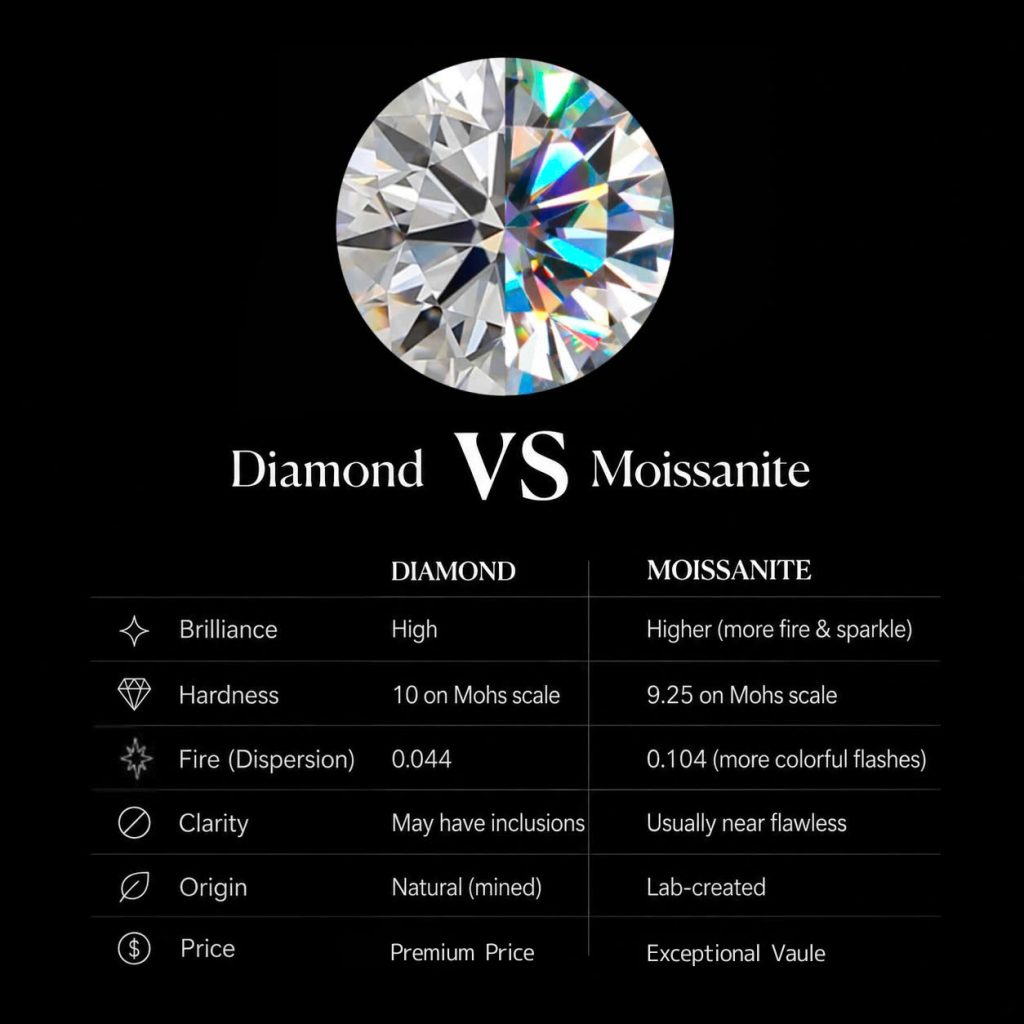
Moissanite vs. Diamond: What’s the Difference?
At first glance, Moissanite and diamonds look remarkably similar. Both offer exceptional brilliance and sparkle, making them popular choices for engagement rings and fine jewelry. However, they are entirely different gemstones with distinct chemical compositions, optical properties, and values.
Understanding these differences can help you choose the gemstone that best suits your style, budget, and priorities.
Composition and Formation
The biggest difference between a diamond and Moissanite is what they are made of.
Natural diamonds are formed deep within the Earth under extreme heat and pressure over billions of years. They are composed of pure crystallized carbon.
Lab-grown diamonds are also made of pure carbon. Instead of forming naturally underground, they are grown in highly controlled laboratories using advanced HPHT (High Pressure High Temperature) or CVD (Chemical Vapor Deposition) technology. Chemically, physically, and optically, they are real diamonds.
Moissanite, on the other hand, is composed of silicon carbide (SiC). While naturally occurring Moissanite was first discovered in a meteor crater, it is extremely rare. Nearly all Moissanite used in jewelry today is laboratory-created.
Although all three gemstones may appear similar, their composition is fundamentally different.
Natural Diamonds, Lab-Grown Diamonds, and Moissanite
Once expertly cut and polished, natural diamonds, lab-grown diamonds, and Moissanite can look very similar to the naked eye. However, they serve different markets.
Natural diamonds have traditionally been valued for their rarity and geological origin, making them a classic choice for fine jewelry.
Lab-grown diamonds provide the same beauty, durability, and brilliance as mined diamonds while offering greater affordability and a lower environmental impact. They have become increasingly popular for engagement rings and luxury jewelry.
Moissanite was originally developed for industrial applications due to its exceptional hardness and heat resistance. As manufacturing technology improved, it became widely used as an affordable diamond alternative in jewelry.
Is Moissanite a Diamond?
No.
Moissanite is not a natural diamond, nor is it a lab-grown diamond. It is its own gemstone with unique optical and physical characteristics.
While it closely resembles a diamond, professional gemological laboratories can easily distinguish between the two.
Key Differences Between Moissanite and Diamonds
1. Chemical Composition
- Diamond: Pure carbon (C)
- Moissanite: Silicon carbide (SiC)
This fundamental difference gives each gemstone its own unique properties.
2. Brilliance and Fire
Diamonds are prized for their balanced combination of brilliance (white light) and fire (coloured flashes).
Moissanite has an even higher dispersion than diamond, meaning it produces significantly more rainbow-coloured flashes under direct lighting. Some people love this vibrant sparkle, while others prefer the more natural brilliance of a diamond.
3. Hardness
Hardness measures a gemstone’s resistance to scratching.
| Gemstone | Mohs Hardness |
|---|---|
| Diamond | 10 |
| Moissanite | 9.25–9.5 |
Both gemstones are highly durable for everyday wear, although diamond remains the hardest natural material known.
4. Diamond Testers
Many traditional handheld diamond testers measure thermal conductivity.
Because both diamonds and Moissanite conduct heat efficiently, both can trigger a positive result on basic diamond testers. Professional jewelers use advanced testing equipment that measures additional optical and electrical properties to accurately identify each gemstone.
5. Density
Diamonds are slightly denser than Moissanite.
As a result, a Moissanite cut to the same dimensions as a one-carat diamond will actually weigh slightly less.
6. Refractive Properties
Under magnification, trained gemologists can identify subtle differences.
A diamond typically displays crisp, single facet reflections, while Moissanite often exhibits double refraction, creating a slight doubling of facet edges when viewed under magnification.
7. Internal Characteristics
Every gemstone contains unique internal features.
Diamonds may contain natural crystal inclusions, tiny mineral deposits, or cloud-like formations.
Moissanite typically displays different growth patterns and inclusions resulting from its laboratory manufacturing process.
Which Should You Choose?
The right choice depends on what matters most to you.
Choose a natural diamond if you value rarity, geological origin, and long-standing tradition.
Choose a lab-grown diamond if you want a real diamond with identical beauty and durability at a significantly better value.
Choose Moissanite if you’re looking for an affordable gemstone with exceptional sparkle and excellent durability, while understanding that it is a different gemstone—not a diamond.
Discover Premium Lab-Grown Diamonds at NamieGems
At NamieGems, we specialize in IGI-certified lab-grown diamonds that offer the same brilliance, hardness, and beauty as natural diamonds. Every diamond is carefully selected for exceptional cut, colour, and clarity, giving you outstanding quality and lasting value for your engagement ring or fine jewelry.
Whether you’re comparing Moissanite and diamonds or searching for the perfect centre stone, we’re here to help you make a confident and informed choice.
