
The History and Evolution of Lab-Grown Diamonds
For centuries, diamonds have captivated people with their extraordinary beauty and remarkable durability. Among all naturally occurring materials, diamond is the hardest known substance, capable of scratching virtually any metal or gemstone. This exceptional hardness has made diamonds valuable not only in jewelry but also across a wide range of industrial applications.
However, a diamond’s true allure extends beyond its strength. Its unmatched brilliance comes from its unique optical properties, including exceptional light reflection, dispersion, and scintillation. When expertly cut, a diamond transforms light into dazzling flashes of brilliance and fire, making it one of the world’s most sought-after gemstones.
From Carbon to Diamond
One of the most fascinating facts about diamonds is that they are made from a single element—carbon. The same carbon found in graphite, the material used in pencil lead, can become a diamond when its atoms are arranged in an entirely different crystal structure.
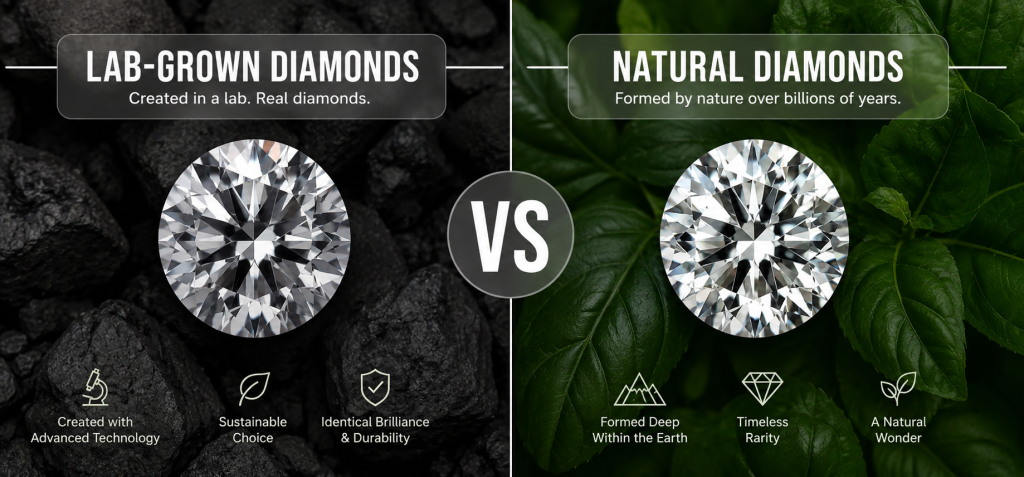
Natural diamonds form deep within the Earth’s mantle under extreme heat and pressure over billions of years before volcanic activity carries them closer to the surface.
Scientists eventually wondered whether these natural conditions could be recreated in a laboratory. That question led to one of the greatest breakthroughs in materials science.
In 1954, researchers at General Electric successfully produced the world’s first laboratory-grown diamond using the High Pressure High Temperature (HPHT) process. This achievement demonstrated that genuine diamonds could be created by replicating the conditions found deep beneath the Earth’s surface.
Early Lab-Grown Diamonds
The first generation of lab-grown diamonds was developed primarily for industrial use rather than fine jewelry.
Early manufacturing methods often produced diamonds with a noticeable yellow tint due to trace nitrogen impurities. Crystal growth techniques were also less refined than they are today, resulting in gemstones that lacked the optical quality expected for luxury jewelry.
Because of these limitations, early synthetic diamonds became valuable cutting, drilling, and polishing tools while natural diamonds remained the preferred choice for engagement rings and fine jewelry.
Advances in Diamond-Growing Technology
Over the past several decades, diamond-growing technology has advanced dramatically.
Today, laboratories use two highly sophisticated methods:
- High Pressure High Temperature (HPHT), which recreates the intense pressure and heat found within the Earth.
- Chemical Vapor Deposition (CVD), which grows diamonds atom by atom from carbon-rich gases inside a controlled chamber.
These technologies now produce diamonds with exceptional colour, clarity, and crystal quality. Many lab-grown diamonds achieve D–F colour grades, VS1–VVS clarity, and Ideal cut proportions, meeting the same grading standards used for natural diamonds.
Every premium lab-grown diamond can also be independently graded by respected gemological laboratories such as IGI and GIA, providing buyers with complete confidence in its quality.
Can You Tell the Difference?
To the naked eye, a high-quality lab-grown diamond is visually indistinguishable from a natural diamond.
Both are genuine diamonds composed of pure crystallized carbon. They share the same hardness, brilliance, fire, scintillation, and optical performance.
Even experienced jewelers cannot reliably distinguish between them through visual inspection alone. Specialized laboratory equipment is required to determine a diamond’s origin.
For everyday wear, there is no visible difference between a mined diamond and a lab-grown diamond.
The Future of Fine Jewelry
As consumers increasingly value innovation, sustainability, and exceptional value, lab-grown diamonds have become one of the fastest-growing segments of the global jewelry industry.
They offer the beauty and durability of a natural diamond while making larger, higher-quality diamonds more accessible. Combined with advances in cutting, certification, and craftsmanship, today’s lab-grown diamonds represent a modern evolution of luxury rather than simply an alternative to mined stones.
Discover Premium Lab-Grown Diamonds at NamieGems
At NamieGems, we carefully select only premium IGI-certified lab-grown diamonds that meet our strict standards for brilliance, cut, colour, and clarity.
Whether you’re choosing an engagement ring, anniversary gift, or timeless piece of fine jewelry, you’ll enjoy the beauty of a real diamond created with advanced technology, exceptional craftsmanship, and lasting value.
